
Let’s be real: most of us don’t think about our dishwashers until they stop working or start leaving “mystery gunk” on our favorite coffee mugs. A question I get all the time—usually from someone whose water heater just bit the dust—is: “Can I run my dishwasher with cold water?”
Some folks say it’ll “blow up” the machine, while others claim modern tech makes hot water obsolete. As a guy who has repaired more Bosch, KitchenAid, and Samsung units than I can count, I’m here to give you the straight talk. We’re going to dive deep into the science of “thermal holds,” why your detergent might be failing you, and how to save your appliance from an early grave.
The Short Answer: Yes, But It’s Complicated
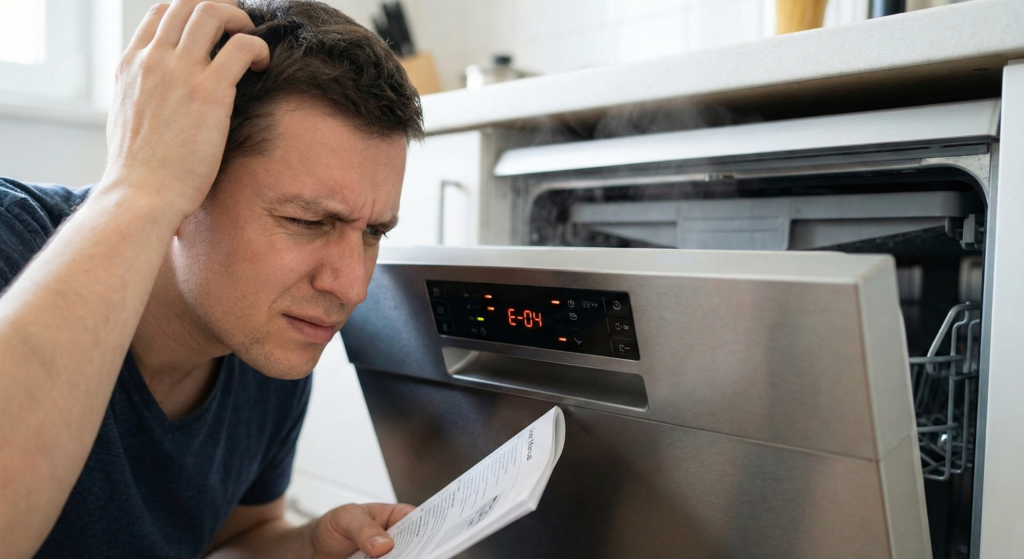
If you’re in a pinch because your boiler is broken, the short answer is yes. Your dishwasher will run. It won’t explode, and it won’t instantly melt. However, “running” and “cleaning” are two very different things.
Most modern dishwashers are designed to be “smart.” They have internal heating elements that act like a giant immersion heater. If the water coming in is cold, the machine will simply pause the cycle and heat the water itself. But this comes with a “tax” on your time, your electricity bill, and the lifespan of your parts.
How Dishwashers Actually Handle Temperature
The Internal Heating Element
Back in the day, dishwashers were basically just “dumb” boxes that sprayed whatever water they were given. Today? They’re high-tech. Most units have a circular heating element at the bottom. When you start a cycle, the dishwasher’s brain (the control board) checks the water temperature. If it’s below a certain threshold (usually 120°F), it kicks on that element.
The “Thermal Hold” – Why Your Cycle Takes Forever
Have you ever wondered why your “Normal” cycle suddenly takes three hours instead of two? That’s called a Thermal Hold. The machine literally stops the clock and keeps the water circulating until it hits the programmed temperature. If you feed it ice-cold water in the dead of winter, that heater has to work overtime.
5 Reasons Why Hot Water is Non-Negotiable for Clean Dishes
Here is the “meat and potatoes” of why heat matters.
1. Detergent Activation: The Science of “Suds”
Modern dishwasher pods (like Finish or Cascade) are engineered to dissolve in stages. Some parts of the pod melt at 110°F, while the “power ball” might need 130°F. If the water is cold, the pod might not fully dissolve. I’ve seen countless “broken” dishwashers that were actually just fine—the owner was just using cold water, leaving a half-melted, slimy pod in the dispenser.
2. The “Grease Factor”
Think about washing a greasy frying pan in the sink with cold water. It doesn’t work; it just smears the fat around. Dishwashers are the same. Animal fats and oils solidify at lower temperatures. You need water at at least 140°F to “emulsify” those fats so they can be rinsed off the plate and sent down the drain. Without heat, you’re just giving your plates a “grease bath.”
3. Sanitization and Bacteria
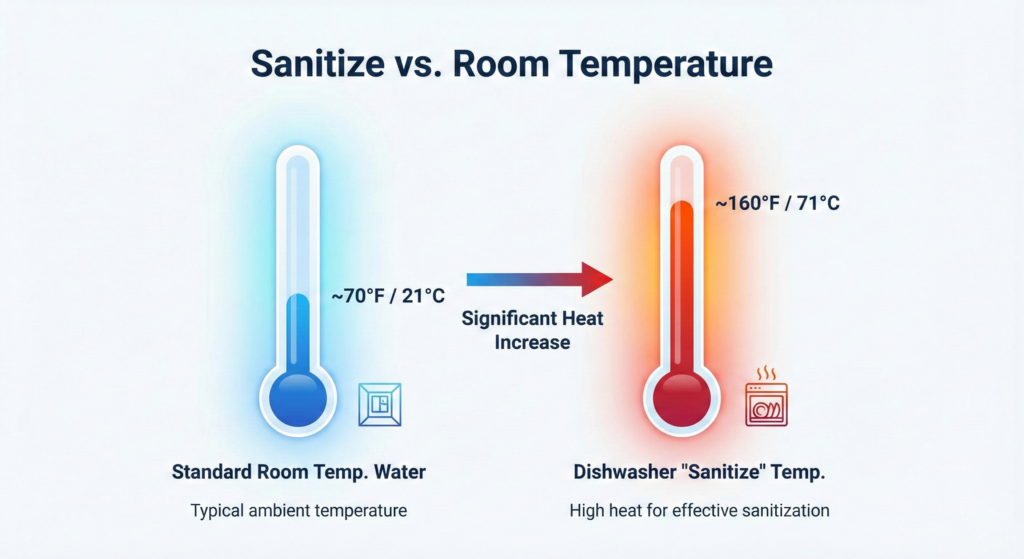
To truly sanitize dishes, the water needs to hit 150°F to 155°F. This is especially important if you have raw meat residue or if someone in the house is sick. Cold water might make the dishes look clean, but the microscopic “nasties” are still hitching a ride.
Connecting to a Cold vs. Hot Water Line: The Pro Debate
The “North American” Standard
In the US and Canada, 90% of dishwashers are hooked up to the hot water line. This is the “lazy” way for the dishwasher to work—it gets hot water instantly, so the internal heater only has to do a little bit of work to maintain the temp.
The European “Cold Fill” Exception
Brands like Bosch, Miele, and Asko often design their machines to be hooked up to a cold water line. Why?
-
Energy Efficiency: They use high-efficiency heaters that only heat the exact amount of water needed.
-
Condensation Drying: These machines use the temperature difference between the hot interior and the cool exterior walls to dry dishes without a heating element. It’s “green” and safer for your plastics.
Expert Tip: Always check your manual. If you hook a “Cold Fill” European machine to a scorching hot 160°F line, you might actually fry the intake valve or mess up the drying cycle.
Common Myths Debunked
Myth #1: Running on cold will cause a “blast” or explosion.
I’ve seen this floating around on old forums. Let’s put this to bed: Your dishwasher will not explode. The worst-case scenario is a “Heating Error” code (like the dreaded E15 on a Bosch) or a tripped circuit breaker. Modern machines have “thermal cut-offs” that kill the power if things get too spicy.
Myth #2: You save money by using cold water.
Actually, it’s usually the opposite. Heating water with your home’s gas boiler is often cheaper than using the dishwasher’s electric heating element. By feeding it cold water, you’re forcing the machine to use its most power-hungry component for a longer period.
Troubleshooting: “My Dishwasher Isn’t Heating!”
If your dishes are coming out wet, cold, and dirty, you’ve got a hardware issue. Here’s what I check first:
-
The Heating Element: Look for cracks or white “calcium” buildup on the loop. If it looks like a burnt piece of toast, it’s gone. You can test this with a multimeter—you’re looking for about 15–30 ohms of resistance.
-
The High-Limit Thermostat: This is a tiny “safety” switch under the tub. If it “trips,” the heater will never turn on.
-
The Diverter Motor: Sometimes the water is hot, but it’s not being sprayed to the top rack. If the top rack is dirty, your diverter is likely the culprit.
The “Pre-Run” Hack: A Maintenance Secret
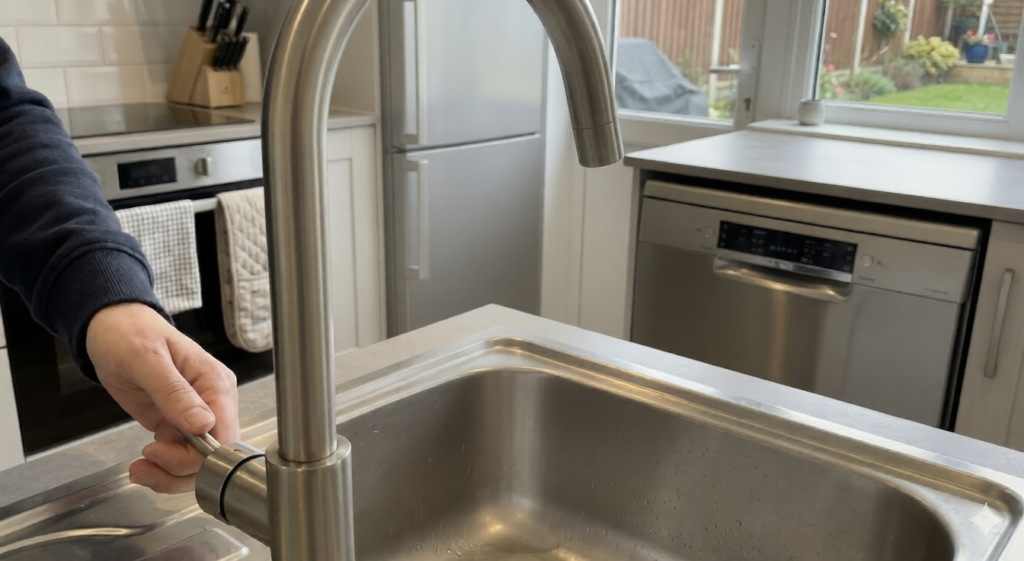
Want your dishwasher to last longer? Run the hot water at your kitchen sink for 30 seconds before you hit ‘Start’ on the dishwasher. Most dishwashers only use about 1 to 2 gallons for the first rinse. If that gallon is sitting cold in your pipes, your dishwasher starts its cycle with an “ice bath.” By priming the pipes, you ensure the very first drop of water hitting your dishes is steaming hot. This “heads-up” saves the machine’s heater from unnecessary strain.
Final Verdict: To Heat or Not to Heat?
While you can run a dishwasher without a dedicated hot water supply, you shouldn’t make it a habit unless your machine is specifically designed for cold-fill.
For the best results, the most “sanitized” plates, and a dishwasher that doesn’t die on you in three years, stick to the 120°F intake rule. If your boiler is broken, go ahead and run a cycle—just don’t expect those “caked-on” lasagna pans to come out sparkling.
Got a weird error code or a leaky hose? Drop a comment below and let’s get that kitchen back in order!